
The Nimitz “Tic Tac” case is valuable because it gives us more than a rumor. It gives us named military witnesses, a reported training-area encounter, an infrared video later acknowledged by the Department of Defense as a real Navy video, and a place in the modern official UAP record.
The short version
In November 2004, Navy personnel operating near the USS Nimitz carrier strike group encountered something unusual during training activity off Southern California. The object became known as the “Tic Tac” because witnesses described it as white, smooth, and shaped roughly like a large oblong mint.
The reason this case still matters is not because the video alone proves something extraordinary. It does not. The reason it matters is that the case has several layers: pilot reports, reported sensor context, military operating environment, and an official later release of historical Navy UAP videos. That combination makes it a serious case file rather than a random internet clip.
What normal people should understand first
There are two separate questions here:
- Is the video real? The public record says the historical Navy videos released by the Department of Defense were genuine Navy videos.
- Do we know what the object was? No public source has provided a final identification for the Nimitz/Tic Tac object.
Those are not the same thing. A real video can still be hard to interpret. A real witness can still be wrong about distance, size, or speed. A government release can confirm authenticity without confirming an explanation.
What reportedly happened
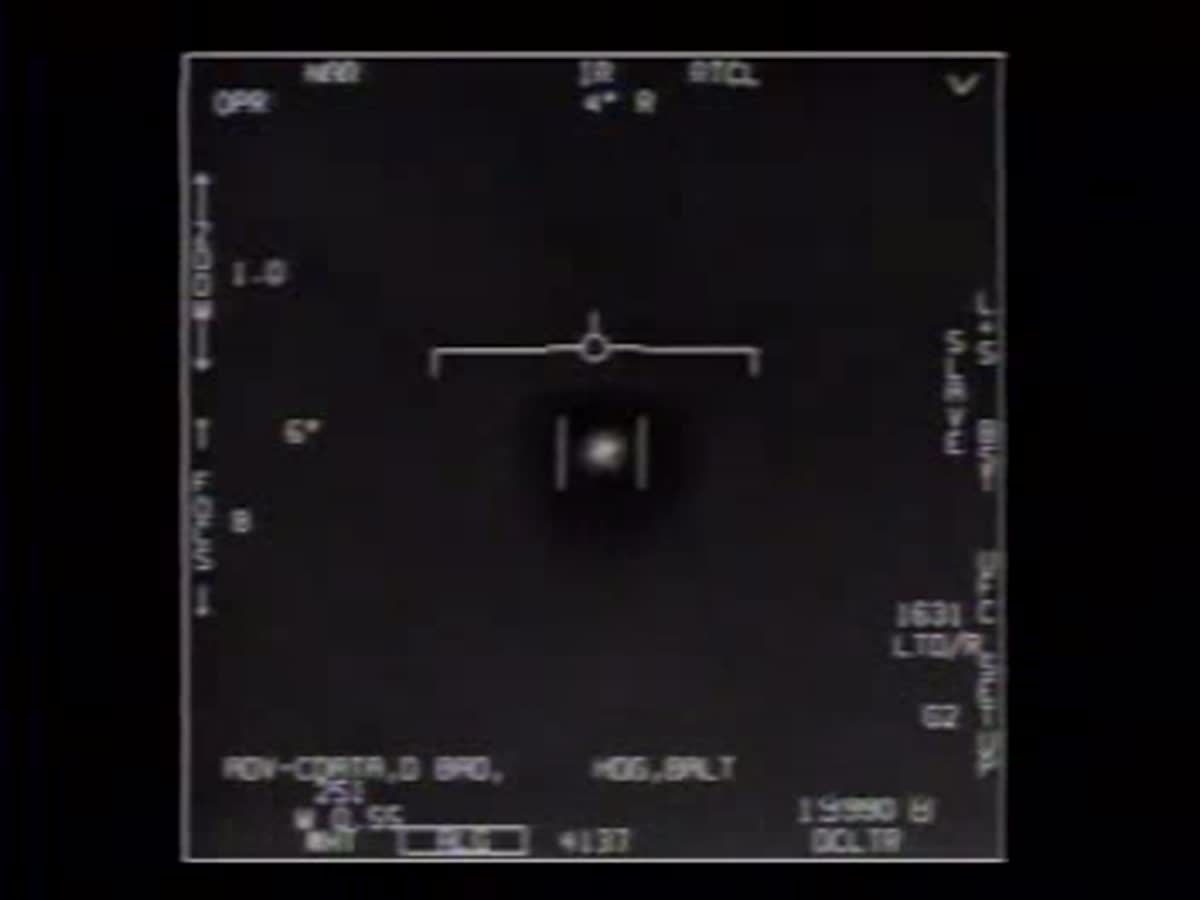
The basic public account is this: Navy aircraft were directed toward an unusual target area during training operations. Pilots later described seeing an object near disturbed water below. The object was described as moving in ways that did not look like a normal aircraft to them. Later, an infrared targeting system captured the video now commonly called FLIR1.
The most important plain-English point is that this was not just a person seeing a light in the sky from a backyard. It was reported by trained military personnel operating in a controlled training environment. That does not make the object automatically exotic. It does make the report harder to dismiss casually.
What the video shows — and what it does not
The FLIR1 video shows a small, bright target tracked by an aircraft sensor. You can see the sensor view, target box, and the moment the object appears to move out of frame or the tracking fails. That is interesting, but it is not a complete case by itself.
The video does not give the average viewer everything needed to calculate the object’s true size, exact distance, speed, altitude, or identity. Without the full sensor data and context, the clip is evidence — but limited evidence.
That is why this case should be handled carefully. The correct conclusion is not “this proves aliens.” The correct conclusion is: “This is a real military UAP-related video tied to a larger reported event, and the public explanation remains incomplete.”
Why the government documents matter
The 2021 ODNI preliminary assessment is important because it marks the start of a modern public baseline. It reviewed reports from 2004 through 2021, placing the Nimitz-era event at the beginning of the reporting window. The report also made clear that the government had limited high-quality data in many cases, which is another way of saying: even official systems often did not capture enough information to settle what happened.
The National Archives page matters for a different reason. NARA now identifies a formal UAP Records Collection, Record Group 615, created under the 2024 National Defense Authorization Act framework. In plain terms, that means UAP records are no longer just scattered references. There is now an official bucket where federal agencies are supposed to identify, prepare, transfer, and release UAP-related records over time.
For The UAP Trail, that is the path forward: not guessing, not sensationalizing, but tracking the paper trail as more records become public.
Evidence strength
Strong
Official release context, military setting, named witnesses, and a video connected to Navy systems.
Limited
The public video does not provide enough standalone data to prove size, speed, distance, or origin.
Open
The public record does not give a final identification for the object.
What makes this different from a normal UFO story
Most UFO stories start and end with a witness claim. This one does not. The Nimitz case has a larger chain: a military environment, multiple accounts, a sensor video, official acknowledgement that the historical Navy videos were real, and later government reporting that treated UAP as a serious reporting and flight-safety issue.
That does not mean every public claim about the case is proven. It means the case is worth filing, tracking, and separating into what is known, what is alleged, and what remains unanswered.
What is known
- The event is publicly associated with Navy operations near the USS Nimitz carrier strike group in November 2004.
- The object was described by witnesses as “Tic Tac” shaped: white, smooth, and oblong.
- A Navy infrared video known as FLIR1 is publicly associated with the case.
- The Department of Defense later authorized release of historical Navy videos and described the aerial phenomena in those videos as unidentified.
- The 2021 ODNI assessment covers UAP reporting from the modern period beginning in 2004.
What is not settled
- The public record does not identify the object.
- The public video does not prove the object’s true speed or size by itself.
- Not every dramatic claim repeated online is backed by an official document.
- The case remains important even if some popular retellings exaggerate it.
The UAP Trail assessment
The Nimitz “Tic Tac” encounter is a serious opening case because it is documented enough to study and unresolved enough to matter. The right approach is to resist both extremes: do not wave it away as nothing, and do not inflate it into proof of a theory the evidence does not establish.
For now, the cleanest label is:
Documented military UAP case. Officially acknowledged video. Publicly unresolved identification.
Follow the trail.