
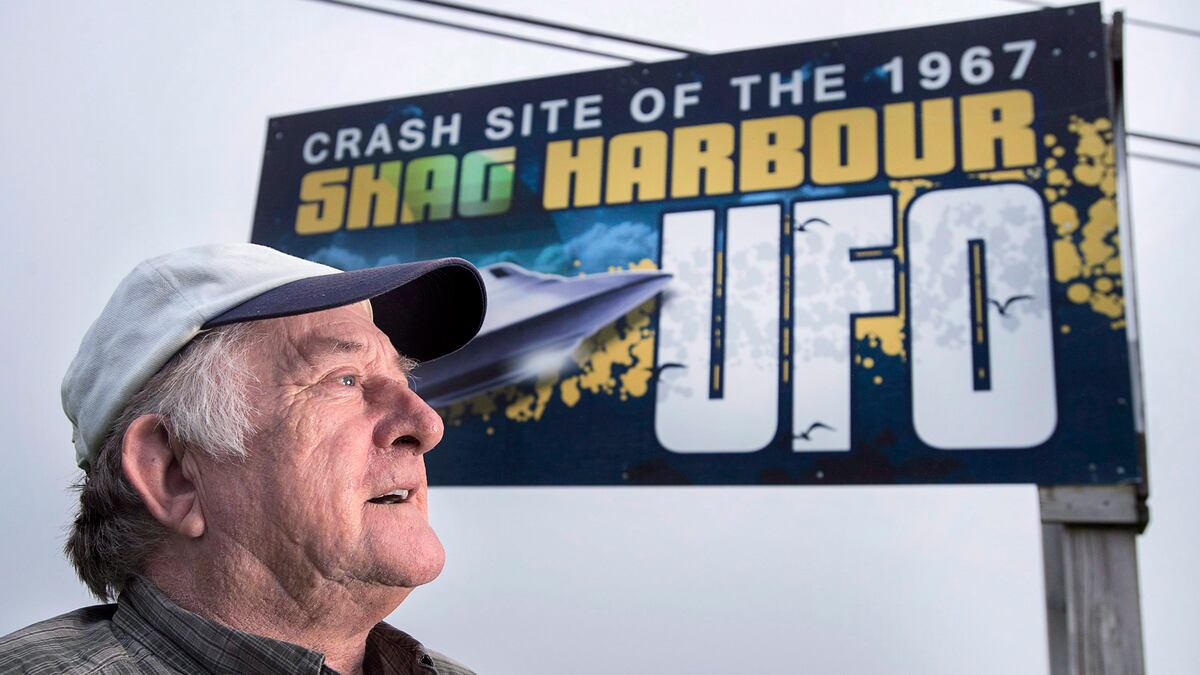
CBC’s new profile of Laurie Wickens is not a fresh sighting, but it is a strong source-backed reason to keep the Shag Harbour file in view: the teenager who made the first RCMP call in 1967 remained tied to the case until his recent death at 76.
The short version
- CBC reports that Wickens was 17 when he saw lights over southwestern Nova Scotia on Oct. 4, 1967.
- He told police the object went into the water off Shag Harbour; more calls followed, and officers later treated it as a possible crash/search event.
- The article preserves named witnesses, RCMP response details, National Defence memo context, and the community-history role Wickens later played.
What the report says
According to CBC, Wickens was driving friends home from a dance along Highway 3 when he saw four lights flashing in sequence and then together. The report says the object appeared to crash into the Atlantic off Shag Harbour, leading Wickens to call the RCMP from a phone booth.
CBC quotes Wickens’s daughter describing the initial skepticism and the quick reversal after police received additional calls. It also cites researcher Chris Styles, who notes the case’s unusually large witness pool, official paper trail, and coast-to-coast attention. One responding RCMP officer, Const. Ron O’Brien, is described as seeing a light floating about 800 metres offshore.
The concrete historical record matters here: CBC says fishing boats searched the water, witnesses described a trail of yellow foam, Canadian Press noted the searched depths, and a 1967 National Defence memo discounted aircraft, flares, floats, and other known objects in its preliminary review before later memo language referred to an unidentified flying object.
Media and records limits
The source media used here is CBC’s article image of Laurie Wickens and the article’s cited archival reporting. It documents people, place, and record history; it is not new visual evidence of the 1967 object itself.
The Shag Harbour incident remains a historical case with witness and records value, not a solved claim. The report supports that something prompted multiple witnesses and official response. It does not, by itself, prove an extraterrestrial origin.
Why this one is worth tracking
- It refreshes a major Canadian case with named family, researcher, police, and records context.
- It links the witness story to search activity and National Defence paperwork rather than folklore alone.
- It helps separate the durable historical record from later speculation around the case.
Open questions
- Which original RCMP, Rescue Co-ordination Centre, and National Defence records are still publicly available in complete form?
- Can the reported foam, light, and search-area details be reconciled across all contemporary witness statements?
- What prosaic candidates were examined at the time, and which were ruled out only preliminarily?