
This is not a modern sighting story. It is a research story about how older records may still be speaking to the present. ScienceAlert summarized a study arguing that mysterious lights recorded on mid-century photographic plates, along with some UAP-era eyewitness data, may correlate with above-ground nuclear testing. The claim is ambitious, and it should be read carefully, but it is exactly the kind of historical research item that gives a UAP archive depth beyond day-to-day headlines.

The short version
- Article type: research/context piece rather than a fresh sighting report.
- Core claim: archival light transients and some UAP reports may correlate with historic nuclear testing activity.
- Time period: mainly the 1940s and 1950s, including the POSS-I sky survey era.
- Why it matters: it tries to connect astronomical anomalies, UAP reporting, and nuclear history in one dataset.
What the research says
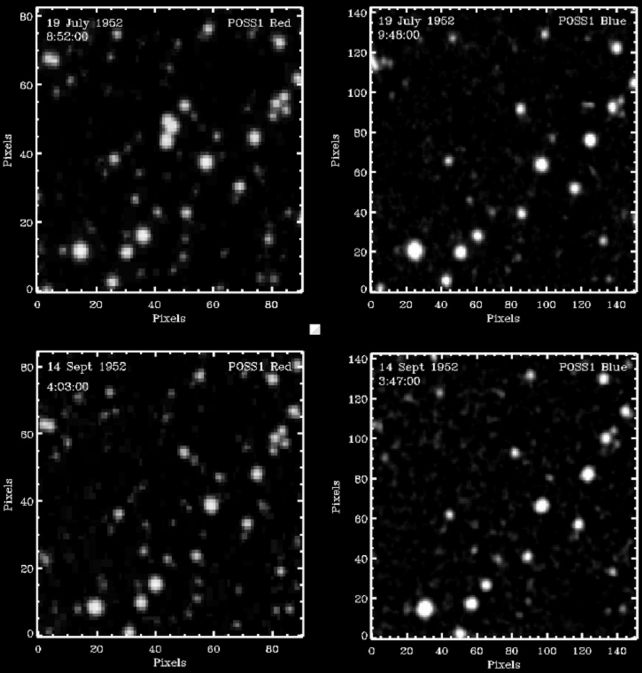
ScienceAlert describes work by Stephen Bruehl and Beatriz Villarroel examining transient lights that appeared on old Palomar Observatory survey plates. The larger argument is that at least some of these short-lived points of light may represent something real in the environment, rather than simple plate flaws, and that their timing may overlap meaningfully with above-ground nuclear testing.
That does not mean the study proves a single cause, much less an exotic one. What it does do is push the conversation away from pure anecdote. Instead of asking only what witnesses remembered, the research tries to compare archival astronomical records, known testing windows, and historical UAP reporting in a structured way.
What the images do — and do not — prove
The source images illustrate the kind of transients the study is concerned with, including multiple-light events that are difficult to dismiss with a single-word explanation. But they are still illustrations of a research question, not a final answer. Their meaning depends on the underlying plate analysis, control checks, and statistical context.
Why this one is worth tracking
It belongs on the site because it expands the archive beyond present-tense sky reports. If your project is going to take historical UAP material seriously, this is exactly the kind of study that deserves a place: specific, debatable, and grounded in data rather than hype alone.
Open questions
- How robust is the reported correlation once alternate explanations and selection effects are fully tested?
- Which plate events remain hardest to explain with ordinary defects or known astronomical causes?
- Does the nuclear-testing connection hold up across independent reanalysis?
- Should this page later link directly to the underlying paper and supporting critiques?