
The short version
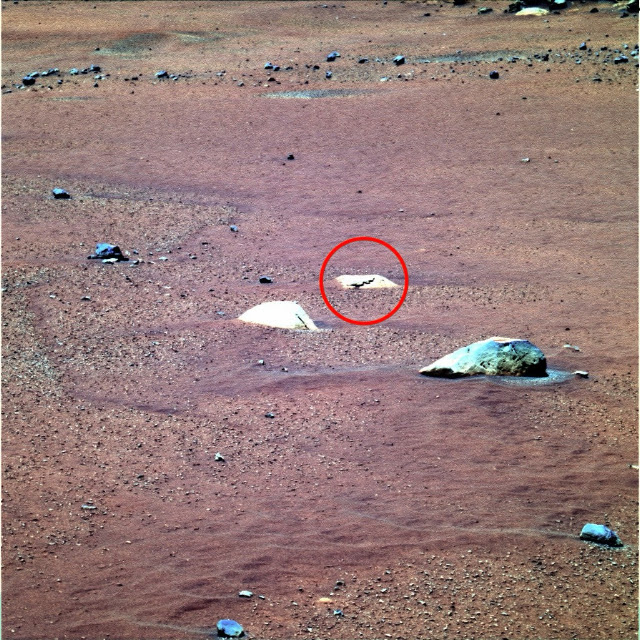
UFO Sightings Daily posted a Sept. 1 source-image lead pointing to a Spirit rover Sol 693 image and interpreting a long feature on a flat Martian rock as a snake-like animal. The concrete material is narrow: a Mars rover image link, the claimed Sol 693 context, and the source author's visual interpretation. The biological conclusion is unsupported from the public source alone.
What the report says
The post gives the discovery date as Sept. 1, 2026 and the location as Mars, tied to Spirit rover Sol 693. It links to an areo.info-hosted Spirit image page with a filename beginning 2P187885128EFFAK00P2580L5M1. The source says the feature resembles a small garden snake, estimates it at roughly half a meter, and speculates that such an animal would need prey, water, and nutrients.
That is where the evidentiary line has to be drawn. A rover image can show an oddly shaped rock, shadow, surface feature, compression artifact, or crop-dependent visual pattern. The source's claim that the feature is an animal is an interpretation, not a demonstrated finding.
Media analysis and limits
The available source media is a blog crop/illustration plus the linked rover-image page. The monitor did not confirm original NASA metadata beyond the source-provided Spirit/Sol 693 citation during this run. No motion sequence, scale calibration, biological analysis, or independent verification accompanies the source post.
Why this one is worth tracking
Image-interpretation claims are common in the UAP-adjacent ecosystem. Tracking them is useful when the source provides a specific mission frame because readers can separate the record that exists — a cited rover image — from the leap the source makes from shape resemblance to biology.
Open questions
- Can the exact NASA/JPL archive page and full-resolution frame be independently confirmed from the areo.info citation?
- What does the uncropped frame show around the feature, and does the shape persist outside the highlighted crop?
- Are shadows, rocks, rover-camera geometry, or compression enough to explain the apparent snake-like outline?
- Is there any corroborating mission science discussion of this feature, or only the later blog interpretation?