
Source-image lead
Leo Minor source-image lead: moon-size object claim enters WorldWide Telescope review
A fresh UFO Sightings Daily post points readers to a WorldWide Telescope view in Leo Minor and describes a large blue form near a red-giant/supernova field. The source gives coordinates and screenshots, but the leap from a sky-survey artifact or astronomical image feature to a living alien craft is the source author's interpretation, not something established by the image alone.
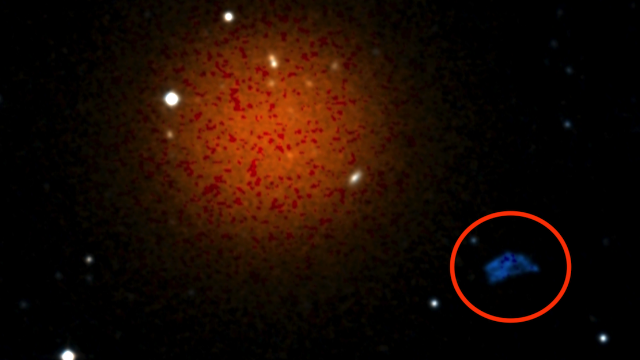
Source-provided image via UFO Sightings Daily/Blogger. It is shown as source media for review, not as proof of object identity.
Source video embedded from the source post. The UAP Trail has not independently authenticated the original recording.
The short version
- Where: Leo Minor constellation / WorldWide Telescope sky view, not an Earth sighting location.
- When: source post lists discovery date as Sept. 15, 2026.
- What was reported: a blue, flat-looking form in a WorldWide Telescope view, described by the source as moon-size and near a red-giant/supernova area.
- Status: non-Earth image-interpretation lead; no independent astronomy, catalog, plate-artifact, or instrument-context review was found in the source material.
What the report says
The source post gives a discovery date of Sept. 15, 2026, names Leo Minor as the location, and links a WorldWide Telescope view at approximately RA 10.79035 and Dec 34.19548. It says the author found a blue flat shape while browsing the public sky viewer. The same post argues the object is a moon-size craft harvesting unusual energy near an exploding-star field and speculates that it could be bio-mechanical. The monitor can preserve the coordinates and screenshots; it cannot treat the alien-craft, energy-harvesting, or living-ship claims as verified evidence.
Media and records limits
The still frame below is source media from the Blogger post, used as a reference to the image lead rather than proof of identity. Public sky-survey tools can show stitching, exposure, catalog, compression, and processing artifacts. A useful next step would be checking the same coordinates in multiple surveys, catalogs, and time bands before assigning any extraordinary explanation.
Why this one is worth tracking
This item is worth tracking because it gives a specific sky-view link and coordinates, making it more testable than a vague image claim. It is not a mappable Earth sighting, so it was not added to the sightings map.
Open questions
- Which underlying survey image or plate is WorldWide Telescope displaying at the cited coordinates?
- Does the same shape appear in other sky surveys or wavelengths?
- Is the feature cataloged, a processing artifact, a reflection, a plate defect, or an astronomical object?
- Can the source author provide the exact viewer settings and timestamp used for the screenshots?