
UFO Sightings Daily is highlighting an elongated feature in public solar imagery and describing it as a giant craft near the Sun. The useful part of the lead is the traceable image claim; the extraordinary conclusion needs primary timestamps, instrument context, and solar-imaging review before it can carry evidentiary weight.
The short version
- Source: UFO Sightings Daily post pointing readers to NASA's GS671 solar imagery portal.
- Discovery date claimed by source: August 2026.
- Reported location: the Sun, based on source interpretation of public solar imagery.
- Core report: the source highlights an elongated dark/bright feature near the Sun and argues it has persisted for months.
- Important limit: this is an image-interpretation lead, not a witness sighting with location, time, distance, or original instrument analysis in the public post.
What the report says
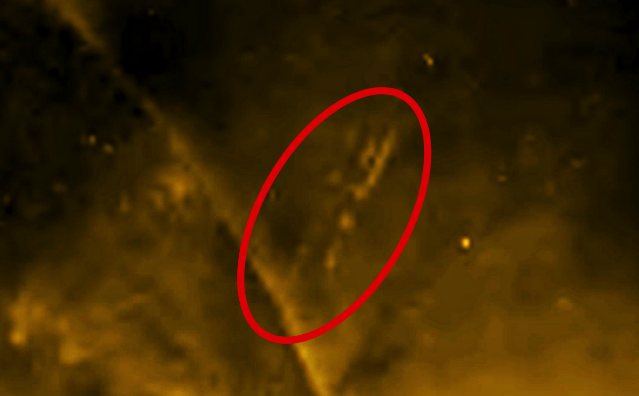
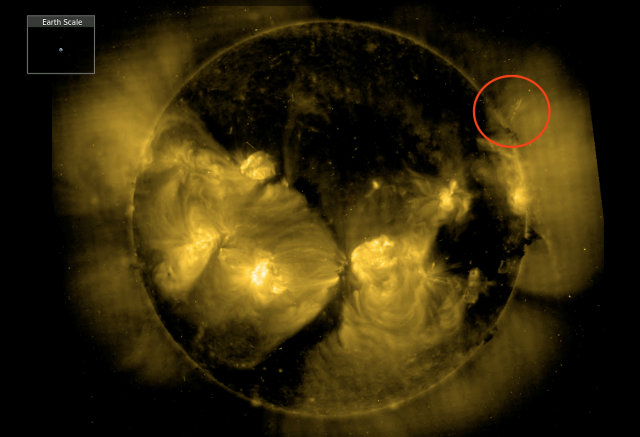
UFO Sightings Daily describes a feature in solar imagery as a “giant UFO” with one end appearing to dip into the Sun. The post says the source location is NASA's GS671/SUSKE imagery site and claims the feature may be roughly ten Earth-lengths long. It also embeds a YouTube video and two stills from the source presentation.
The UAP Trail is treating the concrete lead more narrowly: a public post is pointing to a visible feature in solar imagery and making an extraordinary interpretation about its identity and scale. The post does not provide an independent solar-physics assessment, instrument metadata, a control comparison, or confirmation from NASA that the feature is a discrete object rather than an imaging artifact, coronal structure, processing effect, or ordinary solar phenomenon.
What the media can and cannot show
The stills and embedded video are useful because they let readers see the exact feature the source is discussing. They cannot, on their own, establish that the feature is solid, artificial, near the Sun, or physically interacting with the solar surface. Solar imagery is instrument-dependent, and apparent shapes can be produced or exaggerated by wavelength selection, exposure, compression, viewing angle, plasma structures, and processing pipelines.
The source post includes unsupported claims about a craft harvesting rare particles from the Sun. That claim is not demonstrated by the public evidence. The trackable item is the source image lead and the question of whether a solar-imaging specialist or primary data record explains the feature.
Why this one is worth tracking
This is worth logging because it points to a primary-data pathway rather than only a social-media screenshot: the source names a NASA imagery portal, includes stills, and embeds a video. If the exact image timestamp, wavelength, instrument, and frame sequence can be recovered, the lead can be checked against ordinary solar-physics and imaging explanations.
Open questions
- What are the exact timestamps, instrument settings, and wavelengths for the images shown?
- Does the feature appear in adjacent frames or other solar-observing platforms?
- Can the apparent scale be reproduced from the original image geometry rather than from a screenshot?
- Do solar physicists identify the feature as a known coronal, prominence, artifact, or processing effect?
- Is there any primary-source statement from NASA about the imagery sequence?