
The short version
- Source: UFO Sightings Daily post by Scott C. Waring.
- Discovery date claimed by source: August 7, 2026; post published August 8, 2026.
- Location: Mars, using a NASA / MER Opportunity rover image identified by the source as Sol 121.
- Core claim: the source says a crater-wall shape resembles a fallen bipedal, fossilized body and separated head.
- Important limit: no biological, geological, scale, or mission-team confirmation is supplied in the source. The claim remains an image-interpretation lead, not evidence of alien life.
What the report says
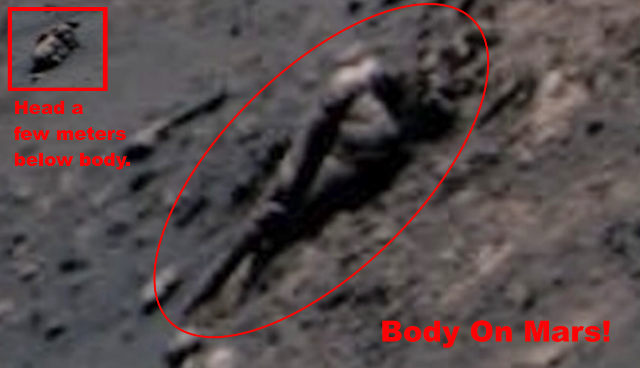
The post identifies the source image as a Mars Exploration Rover Opportunity frame from Sol 121 and links to an areo.info page for the NASA photo. The author says he found a figure on the side of a crater and interprets the shape as a bipedal species that fell or slid down the slope over time.
The source further argues that if the feature were once alive it would have needed to be silica-based rather than carbon-based, and it describes long arms, legs, a chest, and a separated head. Those are the source author's visual interpretations. The concrete facts available to readers are narrower: there is a rover image, a crop on the source page, and a claim that a rock or surface feature resembles a body-like shape.
What the media can and cannot show
The recovered source image is useful because it lets readers see the exact feature being promoted. It cannot, on its own, establish depth, original orientation, scale, material composition, biological origin, or whether the apparent anatomy is more than pareidolia in eroded Martian terrain.
UFO Sightings Daily frames the image as evidence for non-carbon-based life on Mars. The UAP Trail is not adopting that conclusion. For now this is best tracked as a speculative Mars image-interpretation lead that would require the original rover frame, surrounding frames, mission metadata, and geologic context before any stronger claim could be made.
Why this one is worth tracking
Mars-image claims recur often in UAP culture, and most collapse without original-frame context. This one is still worth logging because it gives a specific rover mission, sol, and image link that can be checked rather than a detached social-media screenshot. If the original NASA frame and adjacent images remain accessible, readers can compare the crop against the wider landscape and assess whether the feature is ordinary rock morphology.
Open questions
- Does the original MER Opportunity frame match the crop shown in the source post?
- What do adjacent frames from the same rover sequence show around the crater wall?
- Is the apparent body-like outline still visible when viewed at the original resolution and orientation?
- Can mission geology or lighting explain the shape without invoking biology?
- Has any NASA, rover-team, or planetary-geology source commented on this specific feature?