
The short version
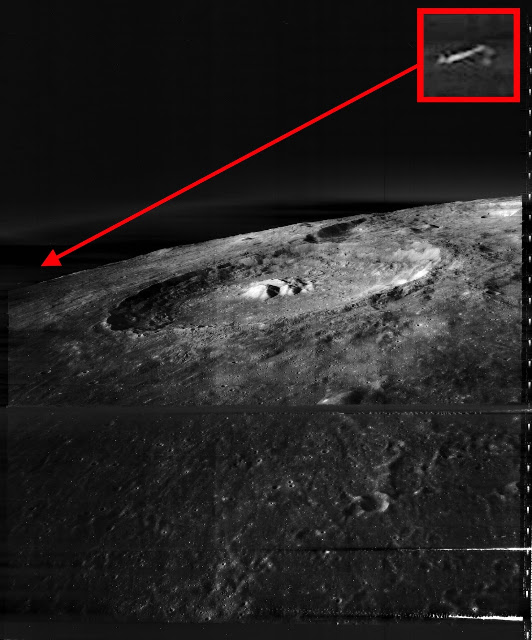
- The source identifies the underlying archive frame as Lunar Orbiter image 3078 from Feb. 23, 1967.
- The post says the feature is near Theophilus crater and estimates its length at roughly 1/20 of the crater diameter, or about 5.5 km.
- The source’s stronger language — that the feature is “100% proof” of aliens watching NASA — is unsupported by the public evidence reviewed for this monitor entry.
- Because this is a lunar-image interpretation rather than an Earth-based witness report, it is not being added to the sightings map.
What the report says
The UFO Sightings Daily post lists the date of the photo as Feb. 23, 1967 and the date of discovery as Aug. 22, 2026. It links the claim to a Lunar and Planetary Institute Lunar Orbiter frame page and says a long form appears above or near the lunar surface.
The source compares the apparent feature with Theophilus crater, which it describes as about 110 km across, and uses that comparison to arrive at a 5.5 km estimate. That measurement depends on the source’s assumed geometry and on treating the visible feature as an object rather than an image artifact, terrain feature, processing mark, or shadow.
Media analysis and limits
The available media for this monitor entry is a source-provided crop/annotation from UFO Sightings Daily. The primary LPI frame page was blocked by a browser challenge during this run, so The UAP Trail is preserving the source link while flagging that the original archive frame still needs direct review.
No source video accompanies the item. This article does not embed unrelated Moon footage, and it does not treat the source annotation as proof of a spacecraft.
Why this one is worth tracking
Lunar archive claims can be useful leads when they point readers to a specific frame number that can be checked later.
The item is also a good example of the monitor’s standard: preserve the traceable source details, then separate them from claims that outrun the evidence.
Open questions
- Can the LPI frame be recovered directly, without the blocked challenge page, and compared against the source crop?
- Does the same feature appear in adjacent frames or higher-resolution scans?
- Could lighting, terrain relief, scanning artifacts, or compression explain the long shape before any exotic interpretation is considered?