
Historical transient-light research can sound abstract until you realize what makes this case unusual: the lights appeared before satellites were in orbit. IFLScience’s article revisits the VASCO project and a newer paper arguing that additional pre-Sputnik transients found on old astronomical photographic plates may represent real light sources rather than obvious defects. Whether that interpretation survives future scrutiny or not, it is the kind of archival material your site should preserve because it broadens the evidence conversation beyond modern cellphone footage.
The short version
- Article type: research/context article, not a live sighting report.
- Main subject: transient lights appearing on old astronomical plates in the pre-satellite era.
- Why it stands out: the events reportedly cluster in years such as 1951 and 1953, before satellites could explain them away.
- Why it matters: it tests whether some historical anomalies were real sky events rather than recording defects.
What the research says
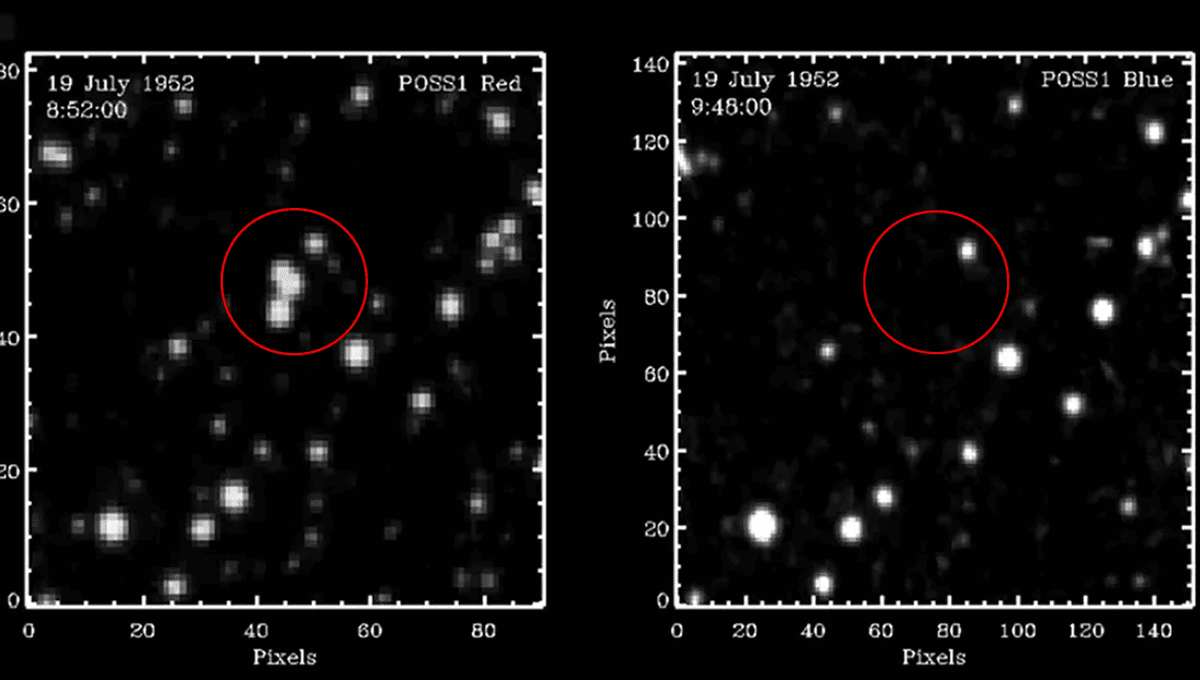
IFLScience frames the story as a continuation of the VASCO project’s older work. The article explains that some brief transients appeared in the Palomar Observatory Sky Survey and then vanished before later observations, raising the question of whether they were merely damaged plates or short-lived real sources of light.
The most interesting point is not that the paper proves an answer, but that it narrows the scope of the mystery. If the lights predate the satellite era and some of them cluster in particular years, then the ordinary modern explanation of reflected satellite sunlight is off the table. That does not automatically make the events extraordinary, but it does make them historically distinct.
What the image does — and does not — prove
The source image is a research illustration, not a smoking gun. It helps anchor the article visually, but the real weight of the story lies in the plate analysis, time clustering, and methodological arguments discussed in the paper and the reporting around it.
Why this one is worth tracking
This article belongs in the archive because it keeps the site honest about scope. UAP research is not only about contemporary eyewitness clips; it is also about whether older observational records contain patterns worth revisiting with modern methods.
Open questions
- How many of the newly discussed transients survive stricter plate-defect screening?
- Why do some of the events appear to cluster in specific pre-Sputnik years?
- How do other astronomers evaluate the VASCO team’s interpretation?
- Should this page later be paired with the ScienceAlert nuclear-tests article as a research cluster?