
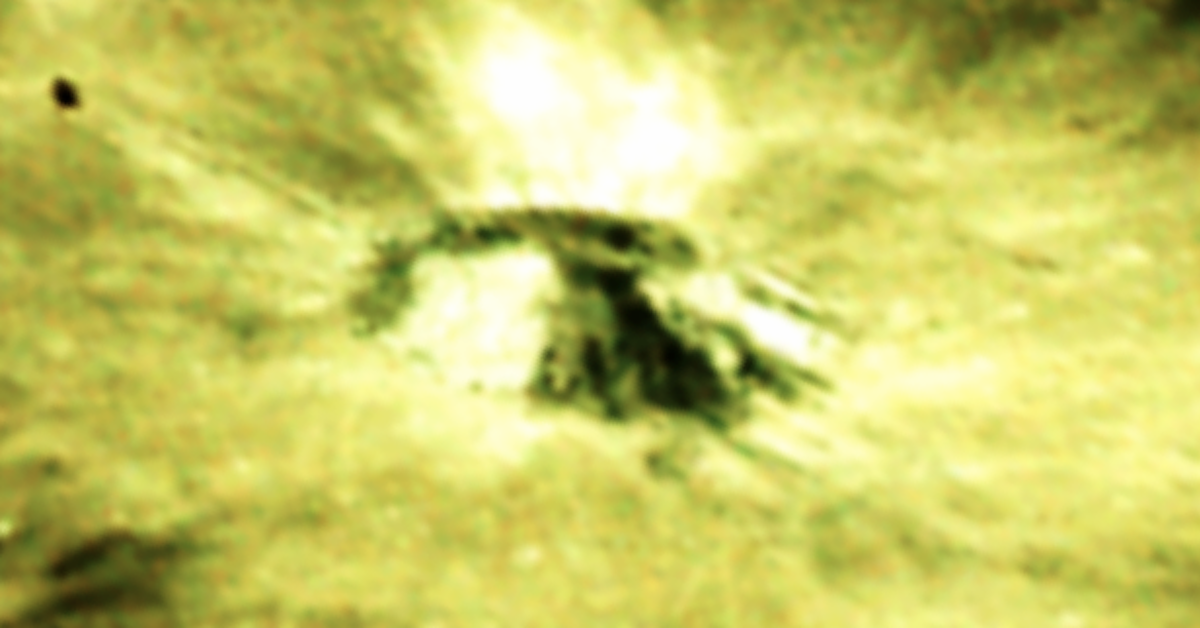
UFO Sightings Daily is pointing readers to an Apollo 10 archive image and arguing that a lunar feature resembles a 1.5-mile-high pyramid. The useful part of the lead is the source image trail; the “building” and alien-origin language remains interpretation, not established evidence.
The short version
- The source identifies the location as Earth’s Moon and names an Apollo 10 archive gallery as the NASA/source-photo lead.
- The post claims a feature in the image is roughly 1.5 miles high, about 2 miles across at the base, and has a flower-like top.
- The same post says contrast was added to make details stand out, so image-processing choices are part of the evaluation.
What the report says
The UFO Sightings Daily article says the author found the feature in an old Apollo 10 mission photo and describes it as visible near the center of the image before contrast enhancement. The post links the source photo trail to an Apollo 10 gallery at tothemoon.im-ldi.com and frames the feature as a very large “structure.”
The article’s concrete facts are narrower than its conclusion: an Apollo-era lunar image is being highlighted, the blogger has supplied annotated/enhanced imagery, and the measurements are the source’s own estimates. Claims that the feature is a building, evidence of aliens, or proof of a lunar base are unsupported by the image alone.
Media and records limits
The media shown here is the source-provided image from the UFO Sightings Daily post. It is useful for checking what the author is pointing at, but it is not a calibrated measurement, terrain model, or official NASA analysis.
Lunar photography can produce misleading shapes through lighting angle, shadow, terrain relief, compression, scan artifacts, and contrast changes. A stronger assessment would need the exact Apollo frame identifier, original unprocessed image, sun angle, scale metadata, and comparison with lunar terrain data.
Why this one is worth tracking
- It is source-linked to an Apollo archive trail rather than only a social-media still.
- It offers a clear example of how speculative image interpretation can travel from a real space-image source.
- The item is useful for reader literacy: source image first, claimed anomaly second, unsupported alien conclusion last.
Open questions
- What is the exact Apollo 10 frame number behind the highlighted image?
- Does the unprocessed archive image show the same contrast and outline?
- Could the claimed shape be reproduced by ordinary lunar terrain and lighting geometry?
- Are there LRO or other modern lunar datasets covering the same area for comparison?